 MarineVerse Blog
From VR to the Water: Polish School Pilot Suggests MarineVerse Can Help Students Prepare for Real Sailing
A school-based pilot in Wisła, Poland compared students who trained with MarineVerse VR against a traditional theory group before a real sailing camp. The early results suggest improved helm confidence, wind-relative orientation, and maneuver awareness.
“Students who had previously attended MarineVerse VR sailing classes were able to take the helm immediately on a 5-person training boat. More importantly, they were ready to use wind angles — not shore landmarks — as reference points for their course. That gave them a major advantage when sailing, tacking, and gybing.”
- Marcin Kotowicz
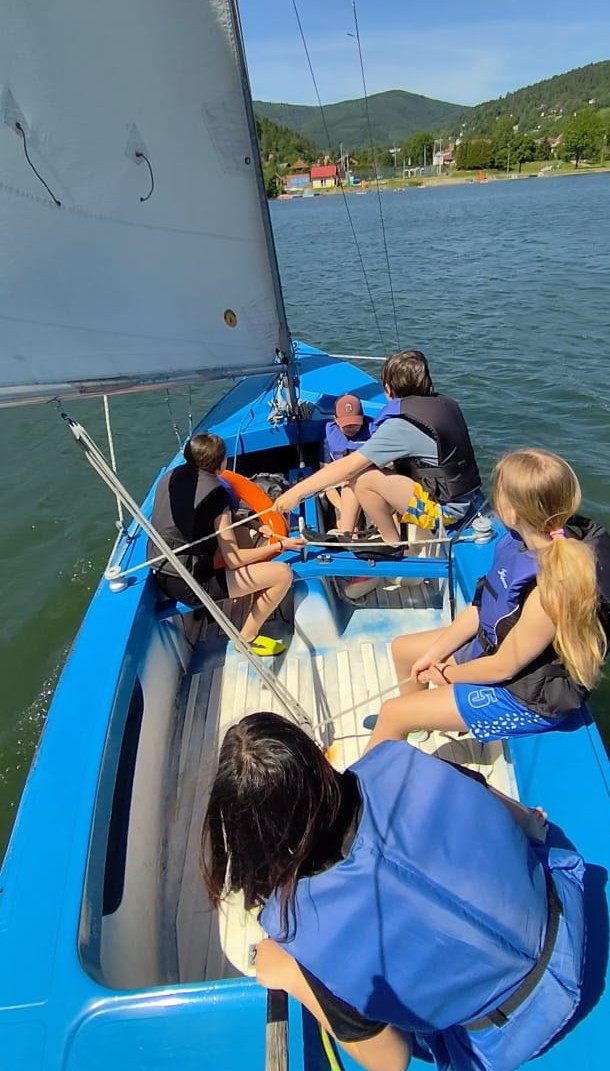
A school-based sailing education pilot in Wisła, Poland has produced a promising early signal: students who prepared with MarineVerse in virtual reality appeared more confident and better prepared when they later moved onto real boats.
The project was led by Marcin Kotowicz at Szkoła Podstawowa nr 1 im. Pawła Stalmacha in Wisła, Poland.
The goal was simple but important: could students develop useful sailing habits in VR before their first real-world sailing experience?
The project compared two groups of primary school students:
MarineVerse VR group: 10 students
Non-VR control group: 10 students
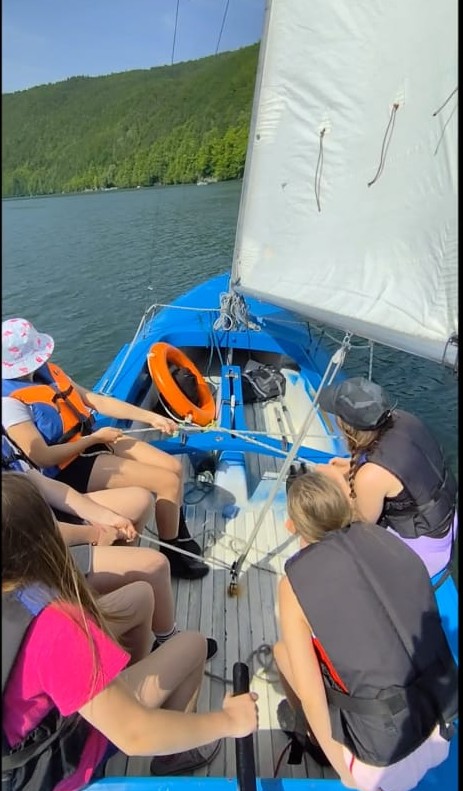
The project ran from December 2025 to May 2026. During the winter phase, the VR group trained using MarineVerse in a school/laboratory setting. The control group received traditional theoretical sailing preparation, including lectures and magnetic sailboat models. In May, both groups attended a school sailing camp and sailed on identical 5-person training sailboats under instructor observation.
Download the full report here.
Winter VR Training
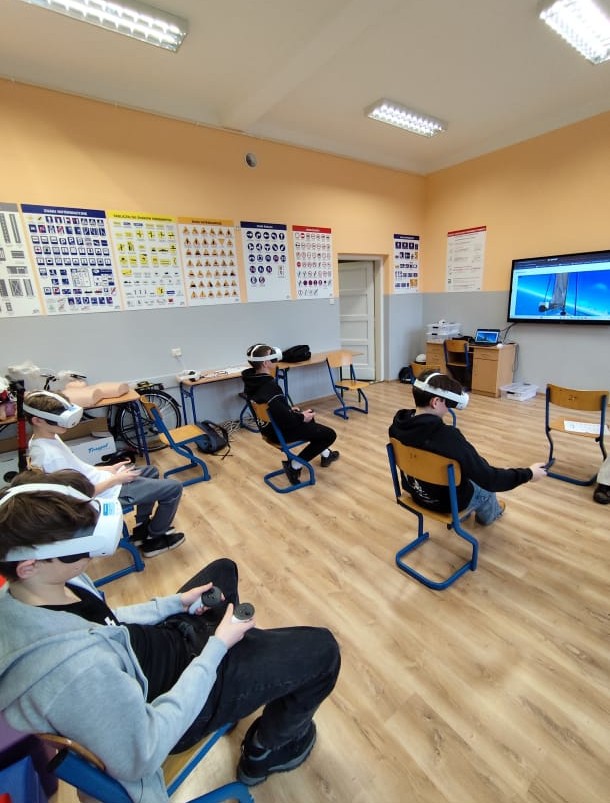
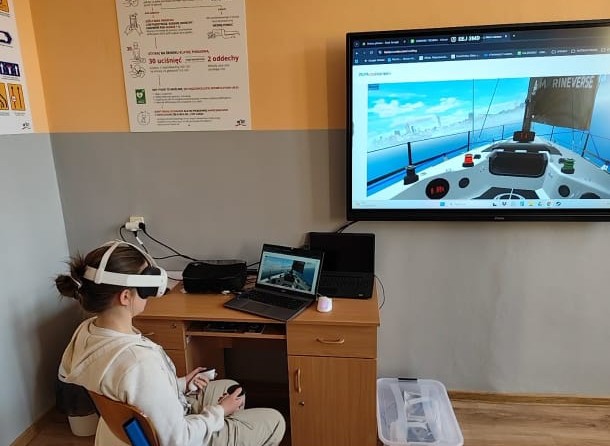
Before the sailing camp, students in the MarineVerse group practiced in VR in the classroom.
Why This Matters
One of the hardest parts of beginner sailing is not just learning what the tiller or sail does. It is learning to think in relation to the wind.
New sailors often orient themselves using land-based references: a tree, a building, a shoreline, or a fixed point in the distance. But sailing requires a different mental model. A sailor needs to understand the boat’s relationship to the wind: close-hauled, beam reach, broad reach, bearing away, coming up, tacking, and gybing.
According to the report, this was the clearest difference between the two groups.
The control group tended to rely on fixed landmarks on shore. When wind direction changed, they were more likely to lose orientation and needed more instructor guidance.
The MarineVerse VR group, by contrast, appeared to use wind direction as the main reference point. Students trained in VR were reported to take the helm immediately, operate at changing wind angles, and perform basic maneuvers with more autonomy.
That is exactly the kind of transfer MarineVerse hopes to support: not replacing real sailing, but helping students arrive on the water with a better mental model.
What the Instructors Observed
During the May sailing camp, instructors observed differences in three key areas:
1. Helm confidence
Students from the MarineVerse group were reported to assume the role of helmsman immediately, with fewer psychological barriers and more intuitive motor coordination.
2. Wind-relative orientation
The VR-trained students appeared to treat wind direction as the main axis of navigation. This was different from the control group, which relied more heavily on fixed points on shore.
3. Maneuver awareness
The MarineVerse group was reported to perform tacks and gybes with more autonomy and awareness of the wind line and sail operation, while the control group required more direct instructor commands and correction after changing course.
In other words, the most interesting result was not simply that students enjoyed VR. The interesting result was that students seemed to transfer part of their sailing decision-making from the simulator to the real boat.
A Promising Pilot, Not Final Proof
This project should be treated as a promising school-based pilot, not a final scientific conclusion.
The group was intentionally small: 10 students in the MarineVerse VR group and 10 students in the control group. The on-water assessment was carried out in real sailing conditions during the spring camp, mainly through instructor observation. The report itself includes a “Scope of the pilot and future development” section to make this clear.
That caution matters.
For MarineVerse, the value of this project is not that it “proves” everything. The value is that it gives us a clear, real-world signal worth studying further:
VR may help beginner sailors build confidence, wind awareness, and basic maneuver understanding before they step into a real boat.
That is a strong and practical hypothesis.
Winter in VR, Spring on the Water

One of the most exciting parts of this project is the training model itself:
Winter in VR. Spring on the water.
For schools, sailing clubs, and youth programs, this model could be very useful. Many sailing communities face seasonal limits, limited instructor time, weather constraints, or student anxiety during the first session on the water.
VR can provide a safe preparation layer.
Students can learn the basics of steering, sail trim, wind direction, and maneuver decision-making before they reach the sailing camp. Then, when they arrive on the water, instructors can spend less time explaining the first principles and more time developing real sailing skill.
The report recommends this kind of winter-to-spring model as a potential direction for modern maritime education.
What Comes Next
Marcin and the school are already looking at a next phase.
The planned continuation would involve cooperation with a local yacht club and prepare students aged 10-14 using VR classes before transitioning to real-world Optimist sailing during a spring sailing camp. This next phase could create an opportunity to measure progress more clearly, including:
- time to take the helm;
- number of instructor interventions;
- ability to identify wind direction;
- tack and gybe independence;
- confidence before sailing.
Future editions could also involve larger groups, simple predefined assessment sheets, and support from sailing, academic, or grant-funded partners. The goal would be to develop this from a successful school pilot into a repeatable model that other schools, clubs, and sailing education programs could test.
MarineVerse is proud to support this next phase with software access.
Credit
School: Szkoła Podstawowa nr 1 im. Pawła Stalmacha
Location: Wisła, Poland
Website: https://www.marineverse.com/sailing-schools/school-waa
Project Lead: Marcin Kotowicz
Technology used: MarineVerse VR sailing platform
We are very grateful to Marcin and the school for testing MarineVerse in a real educational setting, documenting the process, and sharing the results with the wider sailing community.
This is exactly the kind of bridge we hope MarineVerse can help build: from curiosity to confidence, from simulation to sailing, and from the classroom to the water.